
·
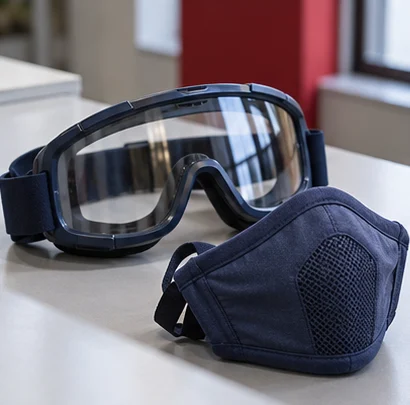
Prior to heading out to the field for a day of recreational airsoft, many of us give our glasses a once over to ensure they are sturdy enough for play. However, the real question is whether or not your glasses are acceptable for use at your venue, and whether or not they are even comfortable enough to wear for long periods of time while on site. Seek assistance from venue staff if your vision, comfort, or confidence to play safely is affected in any way while on site.
Start with the venue's actual requirements
ASTM publishes a specification for eye protective devices intended for airsoft sports, and the ASTM airsoft eyewear specification matters because it describes a reference point for this category of protective equipment. A reader should still distinguish between a published specification, a manufacturer's documentation, and a venue's acceptance of a specific product. Those are related questions, not interchangeable guarantees.
Typically, venues list the types of eye protection that are allowed for players and spectators alike on their safety information webpage (for recreational airsoft), or the individual answering your questions can describe the various models of protective eyewear that the venue allows for participants and spectators, including families, and associated coverage and fit for children of different ages and face shapes.
Even spectators must wear suitable eye protection. Remember the different categories of use (home/recreational/pastime/collectible) and different face shapes, including children, as well as adults. Have a test fit of products you have in your bag before going to an area where you will be an active player. In addition, staff may perform a check on your eyes protection before allowing you to go into an active playing area.
Remember what you said before, write it down and bring it with you. This will ensure that you have all the information required and can refer back to it whilst on site. Most staff are trying to do a job and asking them questions that you have already answered can be annoying.
People often mistake collecting, displaying airsoft guns and playing with them for 3 different types of activity. Unfortunately a museum would be very interested in displaying your old, collector's item airsoft guns but they are not acceptable for use on recreational sites for playing with.
Read labels as evidence, not permission
Instructions supplied with products along with any reference to the design requirements/ categories of the product are useful as evidence of what a product is supposed to be. Try to keep any documentation supplied with a product in the same place as that product.
A 'clear lens' item does not necessarily mean it is safe for play. The item may look more substantial than it actually is and you will need to verify with the venue whether or not the item is acceptable for use at the venue, even though it appears to be suitable. Technical words and descriptions do not necessarily mean an item is acceptable at a venue. Check with the venue before you go to play.
While this sort of documentation is typically of interest when considering a past hobby in a historical context and viewed in a museum (for example packaging, product instructions, a museum catalog description, old site-specific display notes etc.), in terms of ascertaining identity and the item's past use (for the hobby in question) and therefore its acceptability for current use at a venue, such evidence is of little value.
Fit comes before convenience
A product that has been stored in a collection must not be assumed suitable for use due to prior home use. Before donning a product to participate in activities at venues for recreational use, check for a loose fit, undue pressure, un-bes있_ISSUF nost_materialあ__CH til legs and other qualities that may lead to wearers altering the protective equipment to seek comfort. Remember, discomfort with eye protection can lead to wearers removing the eye protection and causing serious injury.
It is also wise to check with the venue in advance as to whether prescription glasses can be worn in addition to and underneath approved safety glasses. Ask the venue for a list of the different safety glasses models and then check the documentation for your own prescription glasses to see if they would be compatible underneath the safety glasses.
A good example as to why this rule is in place is shown below. An individual from outside of Japan visits a recreational airsoft field for participation in a day of activities. He brings an old airsoft gun from his collection to play with. After questioning the individual as to why he needs to wear protective eye wear, he is informed that even though the old airsoft gun is of great interest to be displayed in a museum, it will not be allowed for play at the recreational airsoft field. Collecting, displaying and playing with airsoft guns are three separate purposes.
As already stated above, venues have a number of different types of active areas. Thus, rules for children, as well as adults with different types of faces, are in place for all of these areas. We therefore recommend that you try on all the products in your collection before going to a venue for a visit to an active area and check if they provide a good, adequate fit. Furthermore, the staff at the venue may also inspect your products before you are allowed to enter the active area.
Treat fogging and damage as stop signs
Fogging will impair your ability to see and to move safely about. This is as poor as having scratched or cracked lenses, or even distorted vision, or loose parts, etc. As previously stated, products in your collection will have worked well enough for you to take them out for home use, but do not automatically assume they will be acceptable for use on activities for recreational use at venues.
Dissatisfaction may not arise immediately but problems will arise when an unexpected problem occurs such as an increase in impact or sudden fogging. If this happens whilst participating in activities at the venue then the activity must immediately cease and staff notified.
And, importantly, do not do your own impact tests on your old safety glasses that you brought from home. Don't intentionally try and hit your safety glasses lens(es) to see if they still hold. Also, do not try to modify a safety product in some way to 'fix' problems like fogging or to try to 'make them fit better' to your face, even if you've been using the item for past years for home use, even for rec-use.
Minor damage to protective lenses can cause serious problems including causing a wearer's vision to become blurry or to be in pain. If any such situation occurs then that person must immediately cease all activity and seek medical attention if required.
Spectators need a safety plan too
Even if you or a member of your party are only going to watch others take part in activities, the same set of questions must be asked of the safety equipment for participants and then the same questions asked for the safety of spectators including parents and others outside the activity area. For example, are spectators safe? Is there a safe viewing area? Do spectators have to wear protective eyewear? Is there a boundary where the safety rules apply and not elsewhere?
Even though the spectator will only be watching others, they need to be covered as well. So ask the same questions for spectators (in addition to the participants) like parents, fans, collectors, photographers, researchers, etc. even if they are only watching from outside the playing area. Ask for their safety too and if there is a special area for spectators to watch from and if they need any protective glasses for that area. Bring them along to the site so that staff can point out where the rules apply.
Related articles

What to Expect on Your First Airsoft Venue Visit
Prepare for check-in, the safety briefing and beginner etiquette at an organized recreational venue.
Read More