
·
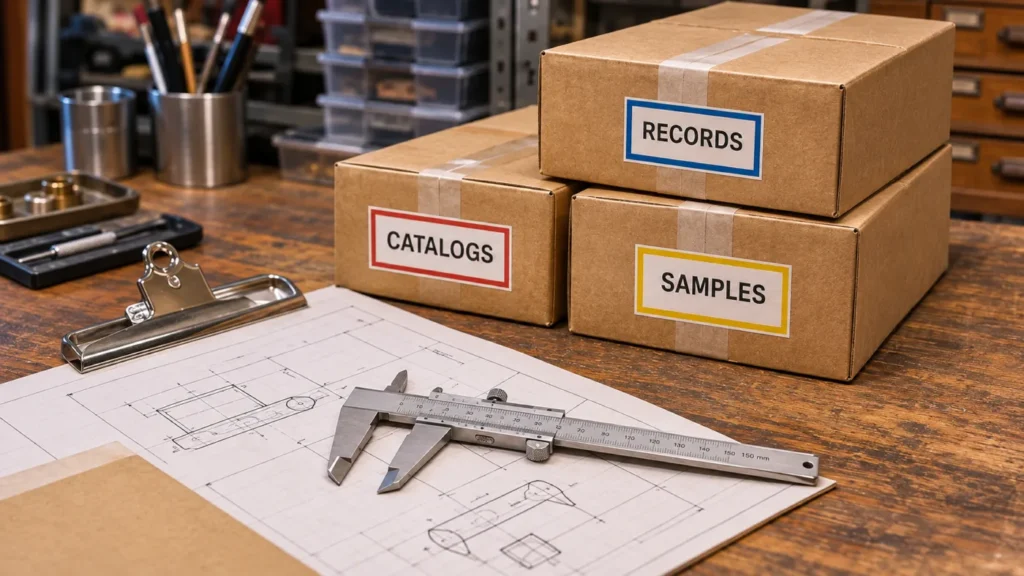
Collectors need to be able to reliably identify versions of the same model, and to note all of the different releases of a model that has been long out of production. Additionally, many models will have gone through design changes over time, and these too need to be noted by the collector. All of this information is very important to write down in order to properly create and manage displays and archives of airsoft models.
Reading a manufacturer through its own record
The Tokyo Marui corporate history matters because it gives researchers a primary corporate reference point. It should be read as company documentation, with attention to what each entry actually says. A chronology can establish that a business reached a particular milestone; it may not settle whether a catalog image represented a planned item, a newly released item, or an example that remained in print after its first appearance.
No origin story for the company is provided here. The history of the company is given for the founding of Tokyo Marui in 1965, the establishment of the in-house mold shop in 1969 and the change of the company name in 1985. The history only outlines the major milestone of the electric-airsoft in 1991 as reported in the official Japanese company product chronology. The history of the models of the company in the catalogs as well as the models as Collectibles are to be detailed in strong notes for cases, for written captions for models, and for model comparisons.
Knowing the source that a collector has used to date a model, the exact words used by that source, and the collector's degree of certainty as to the date given, makes for very useful notes for cases, for written captions for models, and for model comparison. 'Listed in a company chronology' is much better than 'Year Released:'.
Why catalogs deserve a closer look
The Airsoft catalog is so much more than a sales vehicle to buy Airsoft guns. The product names, design language and even terminology that a manufacturer used to refer to an airsoft whilst it was first released, also give the collector an insight into a brand's perception of what a collection of airsofts is.
A printed page of a catalog as proof for a model's publication in that specific publication does not necessarily prove the date of the model's first production. The date of a model's first publication, a model's exhibition, a model's announcement etc. all can be different from each other and even from the date of the model's first manufacture. Thus, even if a model is mentioned in a company's chronology of events published in a later year than when it was first published in a catalog, the date listed in the chronology for that model for its first introduction does not have to be the date of the model's first publication in that specific catalog.
Also, when referencing a printed company catalog, consideration needs to be made to the state of the catalog when it was printed. For comparative research of airsoft models in catalogs, a clean scan of the pages would be suitable for a collectible research exhibit. However, as a museum-style archive of Airsoft, all documentation relating to a product found would be included in the exhibit, including less than perfect copies of a catalog published for the product and full provenance of the copy being described.
The 1991 milestone and the problem of dates
Note again that a single "date of origin" for the model can be given by the available data even though other dates for this milestone in the history of airsoft have been reported by other historical accounts of the company and of the hobby in general (also by other companies than the one under study here). Thus in notes for such an exhibit all such dates should be reported in separate fields, each source clearly attributed.
For an exhibit that lists the date a collectible model was introduced to the market (i.e. its 'birth date'), one would list three dates for a collectible model: 1) the date stated by a company's chronology, 2) the date of the catalog where the collectible was first featured, and 3) the date of a secondary source(s) that tried to date the collectible model after. As such, the 'birth date' of a collectible model given in such an exhibit would be appreciated for what it is: a given point in time based on given data that can be subject to change when more data surfaces.
Collectible models as historical documents
Models of collectible airsoft guns can be viewed in three ways by a collector: as objects, as printed images of the objects and as documents. So, for example, the paint marks on a model, the packaging it was first shipped in, how a model was displayed in a catalog and how models of airsoft guns are related to each other all tell different stories about a model and so all must be carefully cataloged and cared for. Furthermore, a model of an airsoft gun can travel a long time after it was purchased by the original owner, so the history of a model's ownership must also be carefully cataloged and described.
Materials of very limited provenance are another matter of course and certainly 'fully-documented' but of questionable value to anyone wishing to use your collection to answer questions other than perhaps as illustrations to help date design language and present a photograph of a product as it has been presented by the manufacturer and been owned by previous individuals. It is up to you to decide how best to use such items.
To enable making of best models of collectible airsoft the following common errors have to be avoided: a) wrong product name of the time of first release for use as a catalog description, b) models looking today exactly as they did when first released, c) wrong descriptions of products of other collectible airsoft models from other collections. All the above errors can be easily avoided by differentiating between observations and inferences and stating both correctly in captions for models.
Building a responsible research file
So long as you think about the question(s) that you want to answer for a particular collectible you shall be able to amass all of the data required for your research in a note or file that is laid out with fields for Questions, Corporate Chronology, Catalogs and the physical objects that you have collected.
The above information should be recorded and documented. This can be done in the form of a file with the following fields: Questions, Corporate Chronology, Catalogs and Physical Object(s) collected. When recording information from a source the full title of the source should be written down first, followed by a list of the content with the information written down in the original language wherever possible, a note of the page number where possible and whether the information refers to the date of the item's publication, display, announcement or release. A separate note should then be made of your own interpretation of the information above.
Of course, this is not to say that we cannot set up a lovely display of a particular theme using our models in all their colorful delight, nor is it to say that we cannot set up a truly wonderful museum-type archive of our beloved past time, the history of Japanese Airsoft – complete with all the proved history of each and every model (and their various variants) as well as full written copies of all the Japanese corporate history that we have discovered along the way. We just have to remember to correctly note what we actually have and then state our personal interpretation of that as fact.
As collectibles, airsoft models can be seen in three different ways: as objects, as pictures and as documentation. Thus, in addition to written notes for cases, for written captions for models and for model comparisons, also the objects themselves must be treated with due care as they can have traveled a long way from their original owner and their history of ownership must be documented as well as possible. What a model cannot tell the historian about itself must be gathered from other sources, but items of limited provenance that are however 'fully-documented' can be of great value to a historian for fixing the design language of a brand at a certain time and for describing the material presentation of a model and the various stages of its ownership.
Related articles
Japanese Airsoft Manufacturers: A Historical Overview
Use catalogs, packaging and maker records to put different Japanese airsoft companies in context.
Read More